Epic Cutover Success: How Licensed Pharmacists Delivered a Seamless Medication Migration

A case study in clinician-led medication order migration for Epic go-live success

For hospitals preparing for an Epic go-live, few milestones carry more operational risk than cutover. This 24-hour period requires all active patient data to be manually transcribed from a legacy system into the new EHR environment. Orders, medications, and care plans must be moved accurately and efficiently while patients remain in beds and providers prepare for a system shift.

At a public district medical center in California, leadership recognized the inherent risk of relying on internal staff to manage this high-pressure task. Facing a critical pharmacy staffing gap, they partnered with ReMedi Health Solutions to deploy a dedicated team of licensed pharmacists for clinical backloading. The result was a comprehensive, on-time transition that set the foundation for a successful Epic go-live.

The Challenge: A 24-Hour Deadline with No Room for Error

Historically, hospitals have relied on internal clinicians for overnight EHR cutover, often nurses and pharmacists volunteering for extra shifts to manage the transition. This model carries significant operational risks.

Staff Fatigue and Burnout

Expecting internal staff to work overnight and return the next morning for go-live undermines readiness and morale at a time when clinical clarity is critical.

Patient Safety Concerns

Manual medication order migration introduces the risk of transcription errors, especially when completed by exhausted staff under time constraints. In an inpatient setting, these errors can directly impact patient safety.

Tight Operational Window

The hospital had one night to complete all inpatient chart conversions. Delays in data entry would impact patient handoffs, order continuity, and physician readiness at go-live.

Leadership knew a different approach was required: one that treated Epic cutover as a clinical operation, not an administrative task.

The ReMedi Approach: A Purpose-Built Pharmacy Team for Clinical Backloading

ReMedi deployed a specialized team of licensed pharmacists trained in both Epic workflows and clinical documentation. This model provided clinical credibility and operational precision for the most critical component of cutover: medication orders.

Clinical Migration, Not Data Entry

Medication order migration requires clinical pharmacy expertise. Pharmacists must evaluate drug interactions, verify dosage and frequency alignment between systems, navigate best practice alerts (BPAs), and ensure that each order is clinically appropriate for the Epic environment. This is not a task that can be delegated to non-clinical staff or even physicians unfamiliar with pharmacy workflows.

ReMedi’s pharmacists ensured that medication orders were transcribed, reviewed, and verified to maintain exact dosage and frequency alignment between the legacy Meditech system and Epic. This approach preserved the clinical integrity of each patient’s care plan, ensuring that Epic reflected the full, accurate current state of each chart.

Triple-Check Quality Assurance

ReMedi implemented a three-tiered validation process to ensure accuracy and patient safety:

Transcription: A licensed pharmacist entered the order into Epic.

Checker: A second pharmacist cross-referenced the Epic entry against the legacy Meditech record.

Verifier: A senior pharmacist performed final sign-off before the order was made live.

This redundant workflow eliminated the risk of incomplete or inaccurate medication data at go-live, directly supporting patient safety in the inpatient setting.

Hybrid Delivery Model

The engagement utilized a hybrid staffing approach with one pharmacist and one project manager on-site, while the remainder of the team worked virtually. This model allowed ReMedi to rapidly scale resources while maintaining close coordination with hospital leadership throughout the cutover window.

The Outcome: A Seamless Go-Live Morning

By 12:00 AM, ReMedi’s team had completed the full inpatient medication order cutover, finishing four hours ahead of schedule. In the following hours prior to go-live, ReMedi pharmacists continued to review and reconcile any medication changes that occurred overnight, ensuring the most current and accurate data was available when clinicians logged in.

On-Time Completion: Every patient’s medication orders were fully transcribed and validated before go-live, with four hours to spare.

Continuous Reconciliation: Post-cutover reconciliation ensured any overnight medication changes were captured and reflected in Epic.

Fully Rested Internal Teams: Clinical staff arrived on Day 1 ready to engage with Epic rather than recovering from an overnight shift.

“There was a major gap. We didn’t have the pharmacists we needed. ReMedi was able to supplement that, and it would have been impossible to do this without their service.”

– Hospital Leadership

Strategic Insight for Health System Leaders

This engagement reinforces a critical operational principle: Epic cutover is not an afterthought. It is a clinical operation that directly impacts patient safety, provider confidence, and go-live momentum.

ReMedi’s approach to clinical backloading eliminates the risks of fatigue-driven errors, protects internal staffing resources, and ensures a clean transition into the new EHR environment without compromising quality. By deploying licensed pharmacists rather than general consultants or exhausted internal staff, health systems can protect the most vulnerable component of cutover: continuity of care for inpatients.

For health systems planning an Epic deployment, this case demonstrates a scalable, clinician-first strategy to de-risk one of the most fragile stages of implementation. The investment in specialized clinical resources for cutover pays dividends in patient safety, staff morale, and operational readiness from Day 1.

To learn more about ReMedi’s EHR Cutover and Clinical Backloading services, contact us at info@remedihs.com.
Epic Go-Live Support for a Rural Health System

Physician-Led Support That Accelerated Epic Adoption and Built a Foundation for Optimization

The Challenge Facing Rural and Community Hospitals

Rural and community hospitals face a distinct set of pressures during Epic go-lives. Smaller IT teams, limited internal informatics capacity, and physician workforces already stretched thin create conditions where standard consulting models often fall short. Generic at-the-elbow support from analysts or trainers cannot address the clinical reasoning behind workflow decisions. Physicians need guidance from peers who understand both the medicine and the system.

A community hospital in the rural Midwest recognized this challenge as it prepared for its inpatient Epic go-live. Leadership approached the transition as an opportunity to reinforce strong clinical workflows and provider confidence, not simply as a technical deployment.

The Epic system was technically ready, and Epic emeritus physicians were onsite during the early phase of activation. To further support providers during live patient care and ensure smooth adoption across inpatient services, hospital leadership engaged ReMedi Health Solutions to deliver physician-led Epic go-live support.

Engagement at a Glance

Client 100-bed rural community hospital in the Midwest
Engagement Inpatient Epic go-live support
Duration Extended from 1 week to 3 weeks based on early impact
Scope Hospital-wide inpatient and procedural services
Model Specialty-matched Physician Informaticists with daily command center collaboration

Outcomes

Provider Confidence During Live Patient Care

Clinicians reported feeling supported by peers who understood both their clinical decisions and how Epic supported those decisions. Because support was peer-to-peer, providers engaged openly and applied guidance immediately. This dynamic is difficult to replicate with non-physician support staff.

Operational Stability Throughout Transition

Close collaboration between clinicians, IT, and the Epic command center helped maintain steady workflows during the transition. Daily huddles enabled rapid identification of emerging patterns and aligned decision-making across teams, preventing the operational disruptions that often characterize go-live periods.

Extended Engagement Based on Demonstrated Value

Hospital leadership extended ReMedi’s engagement from one week to three weeks. This decision was made during the first week based on the immediate impact physician informaticists had on provider confidence and workflow stability. The extension reflected leadership’s recognition that peer-to-peer clinical support was addressing needs that traditional support models could not.

“I don’t know how we would have gone live without our at-the-elbow support physicians.” – Chief Medical Officer

Approach: Specialty-Aligned Clinical Support

ReMedi deployed Physician Informaticists with direct clinical experience aligned to the hospital’s service lines. The focus was practical application of Epic within existing clinical practice, not theoretical training. Support spanned inpatient and procedural areas hospital-wide, with physician informaticists matched to departments based on clinical background.

Three examples illustrate this specialty-aligned model in practice:

Labor and Delivery

An OB/GYN-trained Physician Informaticist supported clinicians managing admissions, deliveries, and postpartum care. Guidance was provided during active cases, helping providers confidently apply Epic documentation and ordering workflows without disrupting care.

Cardiology

A cardiologist-trained Physician Informaticist partnered with procedural teams, focusing on accurate documentation of interventions, efficient use of Epic tools, and aligning documentation with downstream clinical and revenue workflows.

Surgery

A Physician Informaticist with surgical experience supported the OR and surgical units, ensuring documentation workflows matched the pace of procedural care and that post-operative orders and notes flowed correctly into the patient record.

Day-to-Day Collaboration

Each day began with structured huddles involving ReMedi Physician Informaticists, hospital clinical leadership, IT teams, and the Epic command center. These sessions helped surface patterns early and align decisions quickly.

As inpatient workflows scaled, informaticists identified opportunities to refine order sets, templates, and task sequencing. Adjustments were discussed collaboratively and implemented promptly, keeping teams aligned and maintaining momentum throughout go-live.

ReMedi’s Epic Go-Live Support Model

This engagement demonstrates ReMedi’s comprehensive approach to Epic go-live support:

Physician-to-Physician Clinical Support

Specialty-matched Physician Informaticists provide at-the-elbow guidance during live patient care, ensuring clinical decisions are supported by both peer expertise and Epic functionality.

Specialty-Aligned Deployment

Informaticists are matched to high-impact service lines and clinical departments, enabling clinically relevant guidance and credibility with provider teams.

Real-Time Workflow Integration

Embedded support during go-live identifies workflow gaps, validates order sets and templates, and reinforces clinical safety protocols as they are exercised in live settings.

Collaborative Governance

Daily huddles with clinical leadership, IT, and Epic command center teams align decision-making and accelerate resolution of workflow and technical issues.

Post Go-Live Optimization Planning

Clinical insights gained during go-live inform targeted personalization, provider training, revenue optimization, and system initiatives in the months following activation.

Physician-Informaticist Intelligence: Insights That Shaped Post-Go-Live Planning

The value of physician-led Epic go-live support extends beyond activation. ReMedi’s Physician Informaticists identified three opportunities that shaped the hospital’s optimization roadmap.

1. A Phased Approach to Personalization

ReMedi’s standard approach to personalization spans the full implementation lifecycle. Before go-live, physician informaticists conduct structured personalization sessions where providers build out SmartPhrases, preference lists, and order sets tailored to their workflows. This preparation helps providers start Day One with tools configured for how they practice.

During go-live, informaticists provided real-time personalization support, making adjustments on the fly as providers encountered situations their initial setup didn’t anticipate. This responsive support helped providers stay efficient without pulling focus from patient care.

For deeper optimization, ReMedi recommended a follow-up engagement four to six months post go-live. By then, providers have real-world experience with the system and can make informed decisions about what’s working and what needs refinement. This phased approach, spanning pre-go-live preparation, real-time support, and post-go-live optimization, drives stronger adoption and more durable efficiency gains.

2. Preventing Revenue Leakage Through Go-Live Documentation Support

ReMedi’s informaticists recognized that revenue optimization through HCC coding and risk adjustment cannot be taught alongside Epic system basics. However, waiting until after go-live to address documentation quality creates revenue leakage that compounds over time.

During this engagement, physician informaticists focused on getting providers up to speed on documentation workflows that support accurate coding and risk capture from Day One. This included reinforcing Best Practice Advisory responses and helping providers understand how their documentation connects to downstream revenue performance.

For rural community hospitals operating under margin pressure, preventing revenue leakage at go-live is more effective than trying to recover it later. Physician informaticists can deliver this guidance credibly because they understand both the clinical documentation and its financial implications.

3. Closing Workflow Gaps Before They Become Safety Events

Departmental readiness assessments and task integration walkthroughs revealed workflow gaps that created both operational friction and patient safety risks. Incomplete project planning had left ambiguities in high-risk processes that would typically surface only after go-live through safety events or chart audits.

ReMedi’s Physician Informaticists worked with staff to clearly define workflows for high-risk processes, particularly pathology sample ordering, collection, and labeling. They established clear task ownership and execution steps for each stage.

Physician informaticists identify these gaps because they understand both clinical workflow requirements and system configuration logic. Early identification prevented downstream clinical and compliance issues that would have been far more costly to address after go-live.

Positioning for Long-Term Epic Success

This rural community hospital’s Epic go-live was supported by a strong technical foundation and enhanced through physician-led, specialty-specific support. By embedding Physician Informaticists directly into clinical operations, ReMedi helped providers adopt Epic confidently, maintain focus on patient care, and establish a clear path for ongoing optimization.

The deeper value of physician-informaticist engagement emerges through clinical reasoning applied to implementation challenges. Physician informaticists identify gaps that IT-led approaches might miss, sequence initiatives to respect provider learning curves, and connect clinical workflows to organizational outcomes in ways only clinician partners can articulate.

For rural and community health systems navigating Epic implementations, the choice of go-live support model has lasting implications for provider satisfaction, patient safety, and financial performance.

ReMedi Health Solutions

Clinician-led. Outcome-driven. Epic go-live support designed for health systems that expect more than generic consulting.

Contact ReMedi to discuss your Epic go-live support needs.

Transforming EHR Adoption with Peer-Led Personalization

Discover How a Leading Northeast Health System Achieved 97.8% Physician Satisfaction with Epic Personalization

Transforming Provider Readiness from 61.8% to 95% Confidence Through Physician-Led Training

When a major Northeast health system with 2,500+ physicians across 20+ facilities faced Epic implementation, traditional training methods weren’t enough. With physician readiness averaging just 61.8% and 33% rating themselves as unprepared, they needed a different approach.

ReMedi Health Solutions delivered a breakthrough physician-to-physician personalization model that transformed their Epic adoption:

Exceptional Results:

  • 97.8% satisfaction rating for ReMedi physician coaches
  • 96.3% satisfaction with personalization sessions overall
  • 95.9% of physicians recommended sessions to colleagues
  • 30.4% increase in Epic readiness after a single session
  • 5,000+ personalization sessions delivered across 100+ specialties

The Secret? Clinical Expertise at Scale: Our hybrid virtual and in-person model enabled 350+ sessions per day during peak periods, while maintaining the clinical depth that drives real adoption. Real-time analytics tracked every metric—from session completion to physician confidence levels.

“I had the pleasure of receiving my Epic Personalization training from a ReMedi Physician who was both patient and incredibly informative. They clearly explained the purpose of each icon, guided me through the process, and even anticipated my needs when I wasn’t sure what to ask. His ability to tailor the training to my role within the institution was invaluable. He went above and beyond to ensure I felt confident and equipped, and his support made the entire experience seamless and productive. A true professional and a great guide!” — Physician, Epic End-User

Download the full case study to discover:

  • The specific 3-pillar approach that achieved 95%+ satisfaction ratings
  • How real-time analytics dashboards tracked 2,596 specialists across all specialties
  • Why 2,270+ custom templates and 2,230+ preference lists were built in just 13 weeks
  • The exact methodology that maintained clinic volumes during go-live

Ready to see how physician-led personalization can transform your Epic implementation?


    Achieving Epic Efficiency: How NMHS Transformed Physician Experience with Personalized EHR Training

    How North Mississippi Health Services Enhanced Clinician Efficiency and Confidence with Epic EHR Personalization

    North Mississippi Health Services (NMHS), a leading healthcare provider across Mississippi and Alabama, faced significant challenges during a large-scale Epic EHR implementation. Clinicians struggled with lengthy documentation processes and inefficient workflows, impacting patient care and physician satisfaction.

    By implementing ReMedi’s peer-to-peer virtual training model, NMHS achieved remarkable results through specialty-specific personalization. The clinically-driven, scalable approach empowered clinicians with tailored SmartPhrases, NoteWriter Macros, and optimized SmartSets, significantly improving workflow and EHR usability.

    Download the full case study to explore detailed outcomes, implementation strategies, and learn how NMHS achieved Epic’s Good Install Credit with ReMedi’s proven methods.

    Key Outcomes from NMHS’s Epic Personalization:

    • 97.9% increase in Epic confidence after peer-to-peer training
    • 99.4% rating for ReMedi Physician Coaches
    • Full engagement of Epic Personalization using a fully virtual on-demand model, leading to achievement of Epic’s Good Install Credit
    • System-wide adoption of customized workflows and Epic smart tools optimized by specialty

    Discover How Personalized Epic Training Drives Success
    Complete the form below to instantly access the full NMHS case study and learn how your organization can achieve similar results.

    Download the Case Study Now

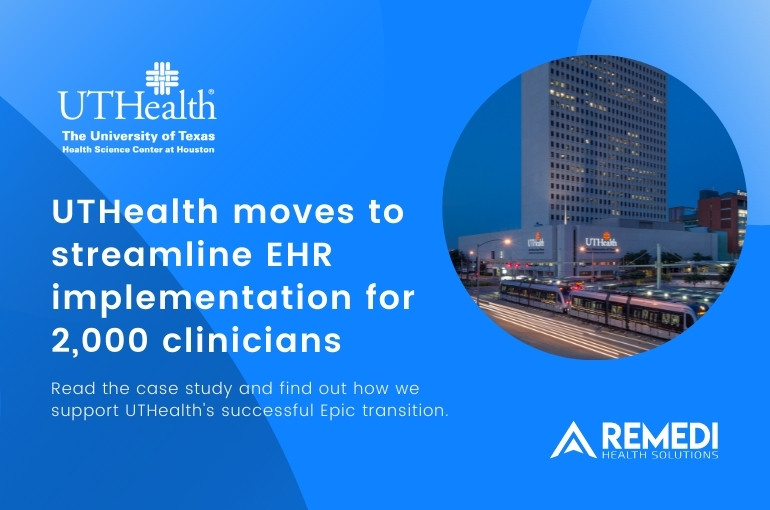
      Case Study: UTHealth moves to streamline Epic implementation for 2,000 clinicians

      ReMedi Health Solutions supported UTHealth through its transition to Epic by providing physician to physician user settings labs, ultimately improving the experience of UTHealth providers using Epic.

      After attending a single User Settings Lab session with ReMedi Physician Informaticists, 98% of providers said they felt more prepared and ready for the Epic Go-Live. Learn more about the statistics, data, and approach in this case study.

      Download the case study below:

        Case Study: Multi-site Ambulatory Epic Go-Live

        ReMedi Delivers a Seamless Multi-Site Ambulatory Epic Go-Live

        ReMedi Health Solutions supported an FQHC through a multi-site Epic ambulatory go-live using a strategic hybrid virtual support model.

        In this case study, we dig into the approach, statistics, and success from this Epic Go-Live.

        Download the case study: