PDF, Guides, Whitepapers, EHR, Healthcare April 23, 2026
How Clinical Informatics Improves Veteran Health Outcomes
How Clinical Informatics Supports Veteran Care During VA EHR Modernization
The Department of Veterans Affairs (VA) is in the middle of the largest EHR modernization effort in federal healthcare, and the stakes at the point-of-care are high. A Veteran admitted during a cutover, a provider reconciling medications across VHA and community care records, a clinical decision support alert firing on incomplete Problems or Allergies data: each is a moment where the quality of clinical informatics work done months earlier determines whether the next clinical decision is safe.
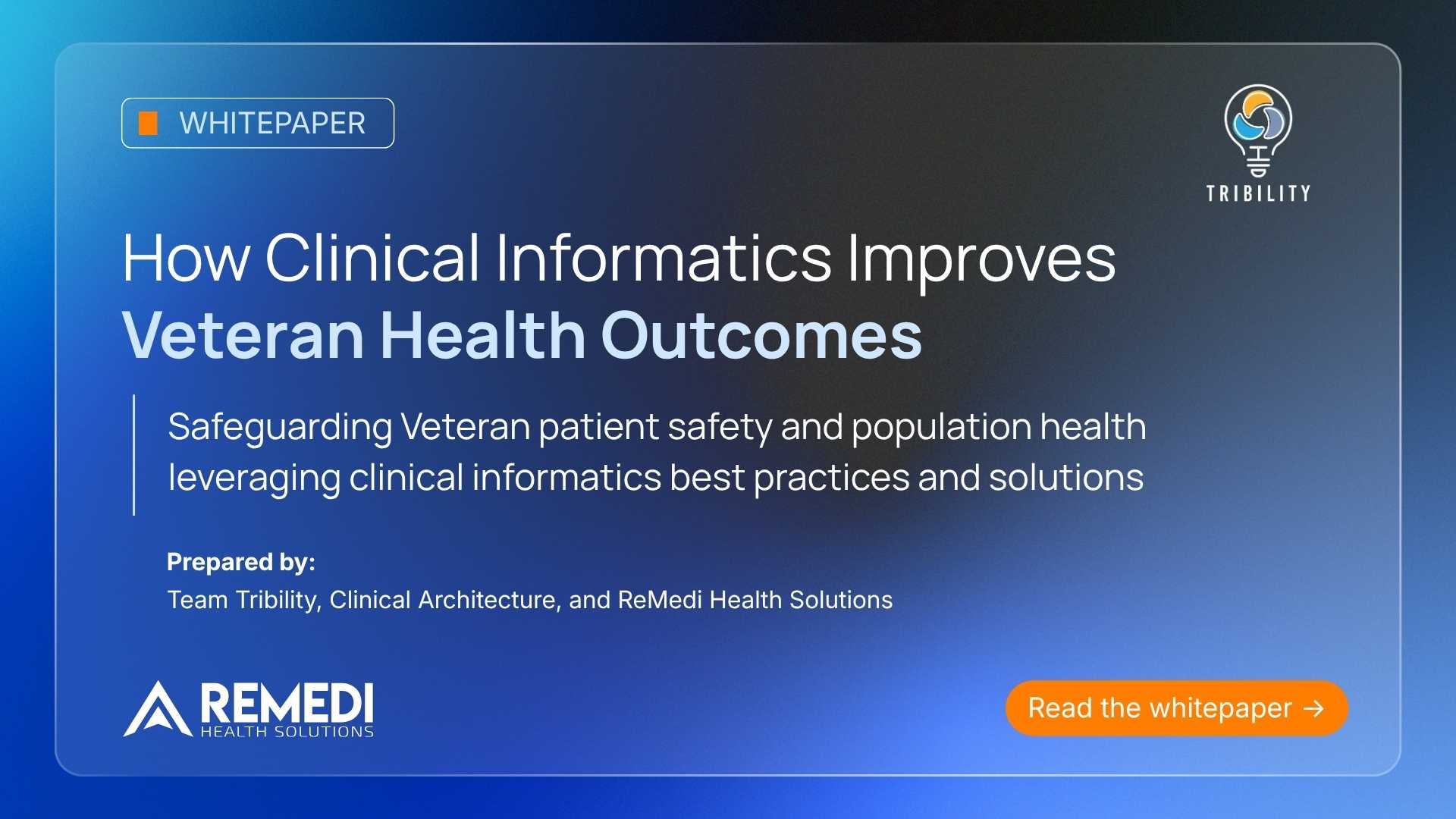
ReMedi Health Solutions, in partnership with Tribility and Clinical Architecture as Team Tribility, has published a new white paper, How Clinical Informatics Improves Veteran Health Outcomes. The paper offers an operational definition of clinical informatics and walks through how disciplined data preparation, interoperability, provider training, and real-time oversight translate into safer, more coordinated care for the more than nine million Veterans enrolled in VHA.
Why point-of-care data readiness is the central challenge
OIG and GAO reviews have documented persistent gaps in medication identifiers, delays integrating community care records, and downtime events that continue to threaten data continuity during and after activation. The whitepaper describes a clinically governed approach to closing those gaps:
- Clinically-governed chart preparation. Experienced clinical abstractors, supported by physician and nursing oversight, systematically review and validate high-value data from legacy EHRs so Problems, Allergies, Medications, Procedures, and Immunizations (PAMPI) are accurate on day one and CDS tools perform as designed.
- Physician-led training and personalization. One-on-one, specialty-specific EHR training and personalization led by physician informaticists, aligning note templates, order sets, and workflow tools to how providers actually practice in VHA settings.
- Interoperability and downtime readiness. Standards-based HL7 and FHIR interfaces paired with downtime planning that protects continuity through system cutovers, with real-time analytics to highlight emerging risks.
- Cutover data continuity for admitted patients. Role-based clinical data entry sequenced across registration, nursing, pharmacy, and physician workflows so active medications, orders, allergies, vitals, and pending results move safely into the new record.
- Analytics-driven oversight. A Real-Time Readiness Command Center that gives leadership visibility into abstraction progress, training participation, readiness scores, alert override patterns, and cutover readiness as it happens.
This is the work that determines whether clinicians trust the record in front of them on day one, and whether EHR modernization delivers its intended value for Veterans and the teams who serve them.
Advancing population health management for Veterans
The white paper also examines how clinical informatics advances population health management across VA. Millions of Veterans live with chronic conditions, including PTSD, traumatic brain injury, diabetes, cardiovascular disease, and toxic exposure-related illness covered under the PACT Act of 2022. Many receive care across both VA medical centers and community providers, and OIG findings show that integrating community care records within required timeframes remains a challenge.
When community care documentation is integrated into the longitudinal record and EHR data is structured for population-level analysis, leadership gains clearer visibility into emerging health trends, care gaps, and resource demands. Care teams can identify Veterans whose conditions are worsening earlier, align screening and outreach with PACT Act presumptive criteria, and intervene before issues become acute. That integrated data foundation is what turns population health from a reporting exercise into coordinated, proactive care.
What else the white paper covers
- Safeguarding Veteran patient safety with quality data, including value set and mapping consistency across VHA, DHA, and Oracle Health exchange pathways using Clinical Architecture’s Symedical platform and the PIQI framework.
- Patient access to health data through My HealtheVet, VA.gov, and the VA: Health and Benefits app, and the growing role of patient-generated health data in chronic disease self-management.
- The strategic landscape of VHA’s Office of Health Informatics, Office of Clinical Informatics, Office of Connected Care, and EHRM Integration Office, and how a coordinated informatics ecosystem supports Veteran care.
- Team Tribility’s operating model, including Integrated Product Teams of clinicians trained in informatics who work alongside VA leadership to design, implement, and optimize solutions.
Read the full white paper
The paper goes deeper on each of these areas, including the Real-Time Readiness Command Center model and operational implications drawn from recent joint VHA and DHA deployments. If you are planning an EHR activation, reviewing population health strategy, or evaluating your clinical informatics readiness, it is a useful reference.