Clinical Care Resilience and EHR Downtime Planning
When the EHR, the lab system, the pharmacy cabinets, and the paging platform are down for a day, a week, or a month, every department needs a workable way to continue essential care. ReMedi assesses readiness department by department, closes the gaps, and practices the response with your teams.

Results our clients confirm
KLAS Research measures ReMedi in the EHR Clinical Optimization segment from verified client interviews. Every engagement is scoped to an outcome and measured against the baseline agreed before work begins, so the results KLAS reports are the results our clients experienced.
100%
100%
45+
Preparing every department for prolonged EHR downtime
Clinical care resilience is a health system’s ability to sustain essential clinical work during a prolonged technology disruption and to restore reliable operations afterward. That means defined essential functions for each department, usable downtime forms and devices, accessible patient information, staff who have practiced the workflows, communication that does not depend on the network, and a defined process for reconciling care delivered on paper.
Most downtime plans cover an outage measured in hours and treat it as an IT event. The Joint Commission’s Sentinel Event Alert 67 recommends preparing for life- and safety-critical technology to be unavailable for four weeks or longer. ReMedi brings clinical and operational leaders to the same table as IT and answers the hour-one questions before the outage.
CIOs, CNOs, CNIOs, COOs, emergency management, and clinical operations leaders
Department by department, rolled up by region and enterprise
Clinical informaticists with nursing, physician, pharmacy, laboratory, and radiology backgrounds
Impact analyzed at 24 hours, 7 days, and 30 days
A readiness scorecard on a 0 to 5 maturity model, repeatable over time
A complete EHR downtime readiness program
Three components that build on each other, from assessment to a practiced response.

Clinical Care Continuity Assessment
Evaluates how clinical operations continue when the EHR and connected systems are unavailable: application tiering and business impact analysis, downtime procedures and forms, device and network readiness, drill history and night-shift proficiency across departments. Produces a maturity scorecard, a risk register and a prioritized twelve-month roadmap for clinical and IT leadership.

Program Enhancement & Remediation
Expert assistance to lead or support resilience improvement efforts. Can be as narrow as form design to full remediation and improvement partnership across the entire spectrum of clinical care resilience.

Simulation and Tabletop Exercises
One time or periodic execution of downtime and/or recovery through simulation s or tabletop exercises to confirm readiness, identify required updates and refinements to resilience workflows, forms, technology, communications, and tracking.
Measuring downtime readiness, department by department
Every department is scored on the same six focus areas, on a maturity scale from 0 to 5, then rolled up by region and enterprise.
- Policies, procedures, and workflows
- Downtime forms and materials
- Staff knowledge and training
- Preparation and practice
- Mitigation options and plans
- Data recovery process
Maturity scale
Scores are anchored to observable conditions, such as whether extended downtime has been drilled and whether an area can manage up to 30 days without core systems.
Impact horizons
Each essential function is analyzed for its effect on volumes, throughput, and staffing.
24 hours
7 days
30 days
Downtime readiness deliverables for leadership
The clinical layer and the technology layer are assessed together, and reported in one deliverable.
- Readiness scorecard and heat map by department, region, and enterprise
- Essential functions inventory for each department
- Downtime forms inventory: usable, needing revision, and to be developed
- Business impact analysis at 24 hours, 7 days, and 30 days, validated with finance
- Recommendation matrix and a twelve-month improvement roadmap
Recovery planning before the outage
Restoring an application does not complete the clinical recovery. Teams reconcile patient identities, review paper documentation, verify medication and result information, and resolve delayed charges and claims. ReMedi defines the sequence, owners, and quality checks for that work.
Which departments participate
Participation follows the essential workflows in scope: nursing, physicians, pharmacy, laboratory, imaging, patient access, health information management, revenue cycle, emergency management, and IT. Cross-department dependencies are a central part of the assessment.
How this relates to federal guidance
The maturity scale is ReMedi's assessment model. It is designed to complement the federal SAFER Guide for contingency planning and supports readiness and governance. The organization remains responsible for its clinical policies, regulatory obligations, and accreditation requirements.
From readiness assessment to a practiced response
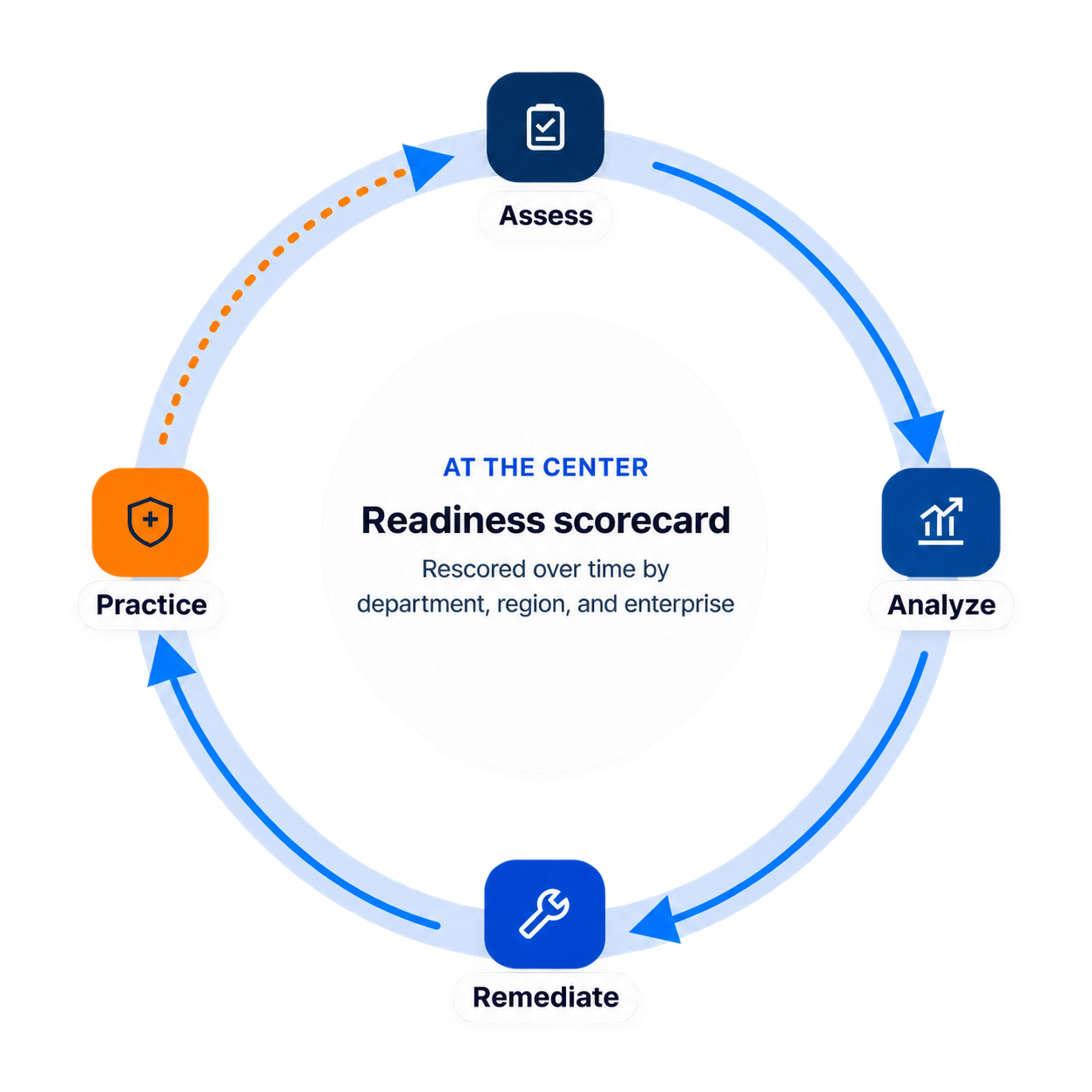
Assess, analyze, remediate, practice. Your clinical, emergency management, and IT leaders guide the decisions; ReMedi leads the work.
01
Assess clinical readiness
Clinical informaticists observe and interview each department, review forms and plans, and identify the four to six essential functions each area must sustain.
Output · Readiness scorecard and heat map
02
Analyze the impact
Each department works through a business impact analysis at 24 hours, 7 days, and 30 days. Finance validates the estimates.
Output · Business impact analysis, validated with finance
03
Remediate the gaps
Findings become a recommendation matrix. Immediate actions are separated from enterprise standardization, and your leaders approve the resulting procedures.
Output · Recommendation matrix and improvement roadmap
04
Practice and plan recovery
Tabletop exercises and shadow simulations test the plan. Recovery and data reconciliation are defined before the outage.
Output · Exercise action records and recovery plan
Scope and timeline depend on the number of departments and are set with the client during scoping. Exercises run while ordinary care continues.
Downtime readiness assessed across 26 departments
Clinical care continuity assessment across two regions
A multi-state integrated delivery network needed an independent, clinically grounded view of whether it could deliver patient care without IT infrastructure for an extended period. ReMedi, in collaboration with a national technology partner, assessed acute care hospitals, a patient command center, a transfer center, ambulatory care, and behavioral health. The assessment became the foundation of the organization’s system-wide readiness program.
383 downtime forms inventoried
40 need revision
113 to develop
26
3
12-month
Understand your readiness before the next disruption
Tell us which departments and essential workflows are your priority. We will discuss your current downtime plans, the gaps you want to understand, and the right scope for assessment, remediation, or exercises.
- A reply from the optimization team, led by Steve Strode
- A conversation about your departments, plans, and priorities
- A tailored scope that aligns with your organizational needs and priorities
Frequently asked questions about clinical workflow optimization
Does this apply only to ransomware?
No. Ransomware is one of the most disruptive causes of downtime, because it can take the EHR and connected systems offline with no warning and for an extended period. It is also one of several triggers. Others include infrastructure failures, vendor and cloud outages, loss of connectivity, and planned downtime. Clinical care resilience prepares each department to keep delivering safe care whatever the cause. The scenarios differ by which systems stay available; the department-level discipline is the same.
How long does an assessment take?
Timing depends on the number of departments and sites in scope. The assessment moves through three phases: on-site observations and interviews, downtime and business impact analysis, and a summary presentation with the action plan. The timeline is set with the client during scoping.
Will exercises interrupt patient care?
No. Tabletop exercises and controlled shadow simulations examine readiness while ordinary care continues. Any exercise that touches live operations requires an agreed scope, clinical oversight, and safeguards.
Does a resilience assessment certify compliance?
No. It provides findings and recommendations that support readiness and governance. The organization remains responsible for its clinical policies, regulatory obligations, and accreditation requirements.
Can ReMedi work with our infrastructure team or technology partner?
Yes. ReMedi delivers this work in collaboration with CDW. ReMedi leads the clinical layer: department workflows, downtime procedures, and clinical readiness. CDW brings the infrastructure layer: recovery tiers, application dependencies, and the technical recovery sequence. If you already have an infrastructure team or technology partner, ReMedi works alongside them in the same way. Either way, the work runs under one steering committee and produces one deliverable.
More Healthcare and EHR Optimization Services
Four areas of optimization focus, matched to the challenges and opportunities.
EHR Personalization and Clinician Efficiency
Peer-to-peer EHR coaching and personalization that gives clinicians time back
Specialty and Enterprise Workflow Optimization
Workflow redesign for a single specialty or a process that crosses departments
Targeted Optimization Specific Initiatives
Focused programs built around one clinical or operational priority